
Knox County Previous Residents by Era
A house history works best when the source fits the period. Current parcel data fixes the present-day address and parcel identity. Recorded deeds supply the ownership chain. McClung's directory and telephone holdings add dated household clues, while federal census schedules provide a separate household snapshot after the required release period. Knox County records reach back to its 1792 founding, but online coverage is uneven. Older deeds, books, and county files may require the Register of Deeds, Knox County Archives, or a library reading-room visit rather than a web result.
| Source | Years It Covers | Where Held | What It Shows |
|---|---|---|---|
| Knox deed and land record tradition | 1792 to present record history; online cutoff not stated | Register of Deeds and older books at Archives | Transfers, legal descriptions, grantors, grantees, and chain references |
| Assessor and CAMA records | Current assessment and tax years | Knox County Property Assessor | Assessed owner, mailing and situs addresses, parcel, class, and legal fields |
| Knoxville city directories | 1859 to present collection; verify annual gaps | McClung Collection and selected scans | Year-specific address, household, and reverse-directory clues |
| Telephone directories | 1898 to present collection | McClung reference desk | Telephone-era name and address leads |
| Federal census schedules | Released under the 72-year rule | NARA and library databases | Household composition and a dated demographic snapshot |
For a recent transfer, start with the parcel and deed trail. For a former household, test the address in a directory year and then pair that result with the nearest released census. A directory line is a lead, not proof that every listed person stayed at that address throughout the year.
Fix the Knox County Address First
Before tracing past residents, preserve the current situs address, parcel ID, subdivision or lot, map or plat reference, legal description, owner display, mailing address, tax year, and search date. The Knox County assessor system separates the parcel's situs address from the mailing destination used for notices. That difference can reflect an estate, trust, lender, family member, or delayed data. It does not establish who occupied the home.
KGIS Maps provides the map cross-reference. Search by address, parcel, owner, place, or other mode, then use the identify tool and parcel reports. Its official geocoder works from address points, so an unsuccessful search should lead to the street core, Address Builder, parcel ID, subdivision, or legal description. KGIS layers also show parcels, buildings, streets, subdivisions, ZIP codes, districts, and historical aerials.
McClung genealogy and house-research guidance recommends beginning with known family material, place, and date. The page is a useful reminder that an address is only a starting point, not a complete history.
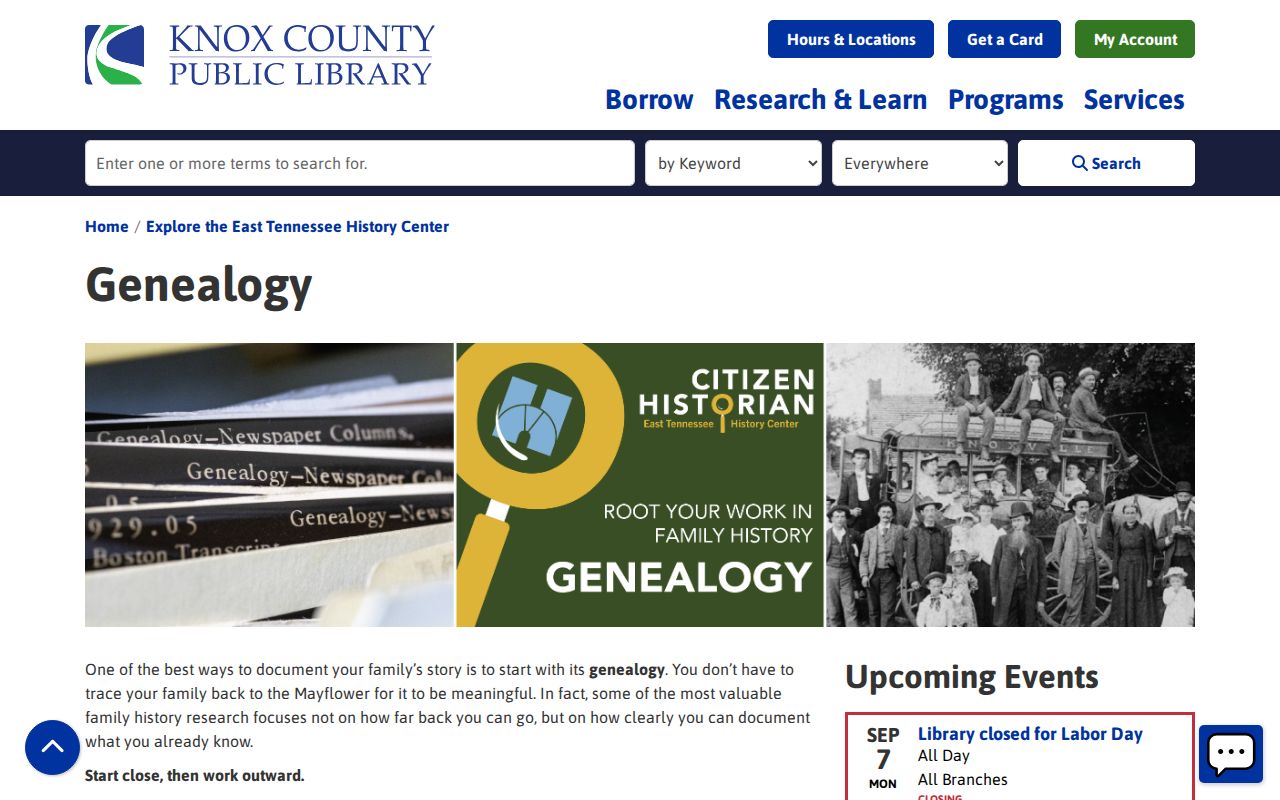
That local-history route helps connect a parcel search to directories, newspapers, maps, and archival questions without treating any one result as the full answer.
Note: Save each spelling, house number, parcel identifier, and cross street before moving backward, because old records may use a different address vocabulary.
Knox County Previous Residents Through Deeds
Ownership is not occupancy, but a deed chain gives the best framework for the past residents of a specific property. The Knox County Register of Deeds is the title source for recorded warranty deeds, deeds of trust, releases, powers of attorney, liens, and related instruments. Its historical-records page describes a Knox County record tradition from 1792 to the present. The public pages do not state an exact online index or image cutoff, so do not assume a missing web result means the chain has ended.
- Use the assessor card to record the current owner, parcel ID, and complete legal description.
- Locate the newest recorded transfer in the Register of Deeds material, where the current owner appears as the grantee, the person receiving title.
- Record the instrument number, recording date, document type, prior grantor, legal description, and any book, page, image, or prior-instrument reference shown.
- Search that grantor as a prior grantee, then repeat the sequence one transfer at a time. Include trusts, estates, spouses, corporate names, and “et al.” where the record uses them.
- When the online trail is incomplete, ask the Register or Archives about deed books, microfilm, plain copies, or certified copies instead of guessing a coverage year.
- Grantor
- The party transferring an interest in a recorded instrument.
- Grantee
- The party receiving that interest. A later grantee search can identify an earlier transfer.
- Chain of title
- The ordered set of recorded transfers used to follow an interest in one parcel backward.
- Legal description
- The lot, plat, subdivision, or metes-and-bounds wording that identifies land more reliably than a changing street number.
The Register of Deeds historical-registers page supplies the county context for this backward trail. Use it with the office's copy procedure when an instrument must be read rather than inferred from a later assessor display.
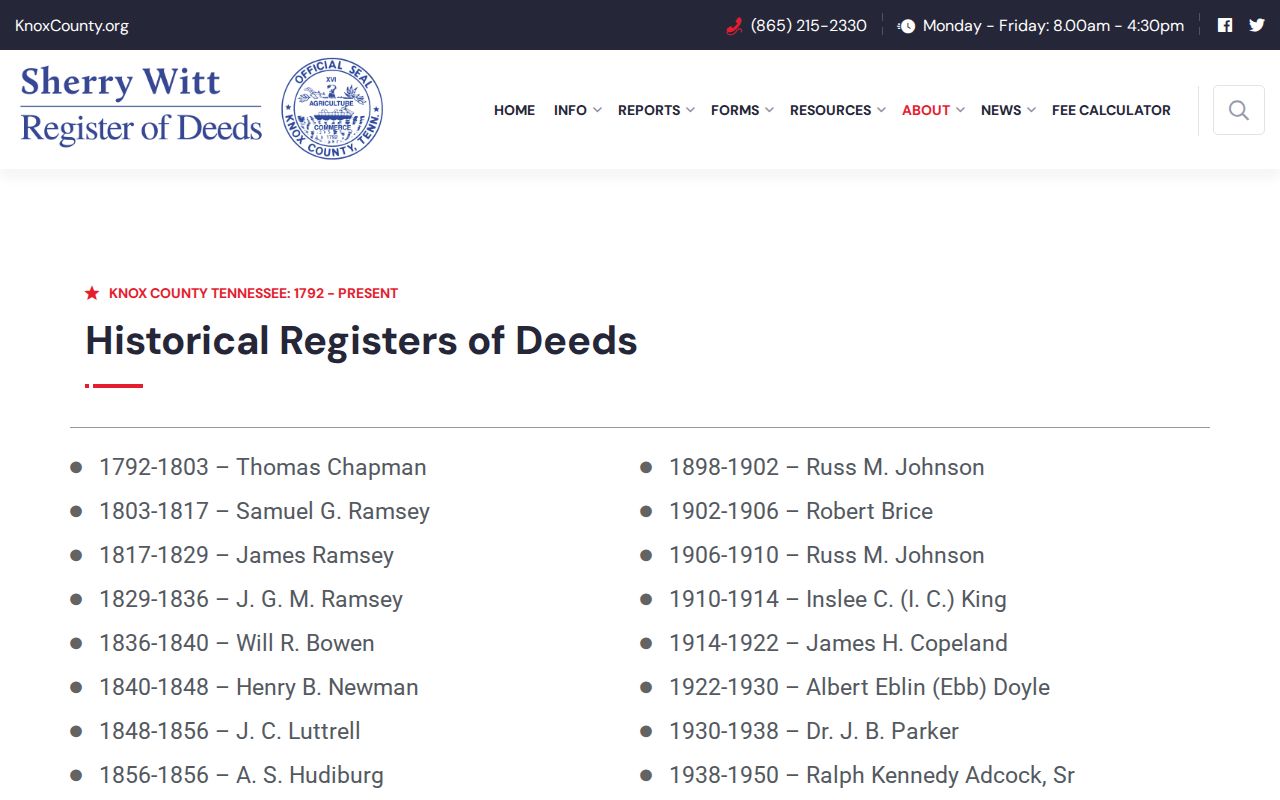
The historical-register material reinforces why an instrument number and legal description matter more than a copied name alone.
Insider Tip: Knox County Legal Descriptions
When an old house number fails, search the parcel's legal description before deciding the record is gone. Knox filings require a legal description and derivation or chain reference, and the assessor card can show subdivision, plat book and page, lot, dimensions, and deeded acres. A plat or metes-and-bounds description can remain stable through a road change, lot split, or revised address.
KGIS parcel lines are valuable research aids, not exact surveys. Use the description to reconcile records, then let a current survey control any boundary question. This is especially helpful where an older directory lists a nearby landmark or a subdivision name instead of a modern address.
Note: A parcel map can support address continuity, but it cannot prove that the same household remained in a building.
Knox County Past Residents in Directories
The Calvin M. McClung Historical Collection holds a rare Knoxville city-directory collection from 1859 to the present and telephone directories from 1898 onward. Collection-wide dates do not guarantee that every volume exists. Check the exact year, then use the name section and any reverse or criss-cross section to connect an address to a dated household clue. The historical collections themselves have fuller detail in the Knox County city directories.
A directory entry can carry a name, residence, relationship notation, business or work line, and sometimes an owner or renter mark. Read the printed abbreviation key and page scan. A 1907 digitized volume demonstrates the familiar compact entry, but OCR can misread initials and abbreviations. Record the directory title, year, page, address, and every variant before comparing adjacent years.
Knox County's broader cross-reference collection includes suburban communities such as Claxton, Concord-Farragut, Halls Cross Roads, Mascot-Strawberry Plains, and Powell from a 1992 onward run. A city label, a county mailing address, and a community name can point to the same general place but should not be collapsed without the volume and parcel context.
Knox County Previous Residents in Households
Previous residents become more credible when a directory year and a census year are read together. Start with the street address and household name in one directory. Search the next available directory for that street, then use the nearest released federal census schedule to test the household composition. Finally, compare the address with a map or deed description, since a census address may be imperfect or absent.
- Make a small ledger with the directory year, page, exact address, name spelling, and notation.
- Check the same street in the next directory and note a move, a new name, or a changed number without treating it as certain proof.
- Pair the date range with the closest released census and retain its page or digital citation.
- Use deeds, maps, and neighboring entries to test whether the property identity stayed constant.
The Knoxville obituary index covers Knoxville Journal notices from 1885 to 1906, and the library cross-index reaches 1991 to the present. It may identify a publication date, relatives, or a death outside the county. Treat it as a lead to the newspaper, certificate, or probate file, not a substitute for one.
Knox County Previous Residents and Building Clues
Maps date the place, not the people. KGIS offers verified aerial options from 1995 through 2022, and its parcels, building footprints, streets, and subdivisions can help test whether a structure or road arrangement changed. McClung holds thousands of historic and aerial or topographic maps. The verified Library of Congress 1917 Sanborn volume has 120 sheets; Sanborn sheets can show footprint, material, use, street setting, and sometimes a house number.
For a Knoxville address, the city work-search index accepts a main street name without directional prefix or street type, or a full parcel or CLT number with no spaces or dashes. Dates, status, and work type can narrow public permit and code results. Historical coverage remains incomplete, so Development Services or a Tennessee Public Records Act request is the fallback for an older file. A work record may date an alteration, but it does not prove who lived there.
Note: Keep map dates and permit dates distinct from residence dates, because construction activity and household occupancy answer different questions.
Myth: Knox County House History Is Online
Knox County's long record history does not mean each volume has a public digital image. The Knox County Archives holds non-current permanent county records beginning with the 1792 founding, including land, court, tax, marriage, divorce, and government material. Staff assist in person, by mail, email, and phone and retrieve records from closed storage. Restricted material remains restricted.
The Archives reading room is in the East Tennessee History Center. Older probate and estate material can be useful at the end of a house trail: estate settlements run 1792 to 1929, Will Book coverage is 1874 to 1939, and the library's probate index points to files from 1954 to 2024. An index is a pointer to a file or book, not a complete list of heirs or residents. Ask for the volume, date range, and parcel or family name needed.
Knox County Previous Residents: Use Limits
House-history and family-history research should stay tied to the parcel and the historical question. Tennessee Safe at Home provides qualifying participants a substitute address for many government interactions. It does not erase real-property records, but it is never a reason to combine assessor, deed, map, or voter material to identify a protected address. Juvenile, adoption, sealed, expunged, protected-voter, and confidential military-discharge records are also outside an ordinary address search.
Lawful personal use. Use Knox County previous-resident records for house history, family research, estate questions, or personal curiosity. Stop when a protected record appears, and never use any result to track, stalk, threaten, or harass a living person.
The Register's free Property Fraud Alert can email a person when a deed or mortgage is recorded in a registered name. It is a name-event alert, not title proof or a substitute for checking the actual instrument.